

Academic Credit:
Participation may be recognized for academic credit: 1 week – 2 credit points; 2 weeks – 4 credit points; 3 weeks – 6 credit points.
The Tell Qana Archaeological Project offers students the opportunity to participate in a research-driven excavation at one of the most recently discovered sites in Israel. Hosted by Bar-Ilan University in partnership with the Israel Antiquities Authority, the program integrates hands-on fieldwork with structured academic instruction, providing a rigorous introduction to professional archaeological practice.
Participants take part in all phases of the archaeological process – from stratigraphic excavation and systematic finds processing to digital documentation and academic seminars – at a site unveiling Bronze and Iron Age remains for the first time. The program is officially recognized as an academic course and offers transferable credit hours, making it ideal for students who want to blend scholarly growth with practical field experience.
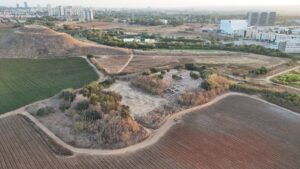
Tell Qana (el-Mokhmar) is situated in a strategic location in the Yarkon Basin, a key corridor for trade and political interaction throughout the Bronze and Iron Ages. The mound preserves a continuous occupational sequence from the Early Bronze Age through the Persian period. This is its first systematic excavations – meaning that every locus and artifact constitutes primary, unpublished scholarly data.
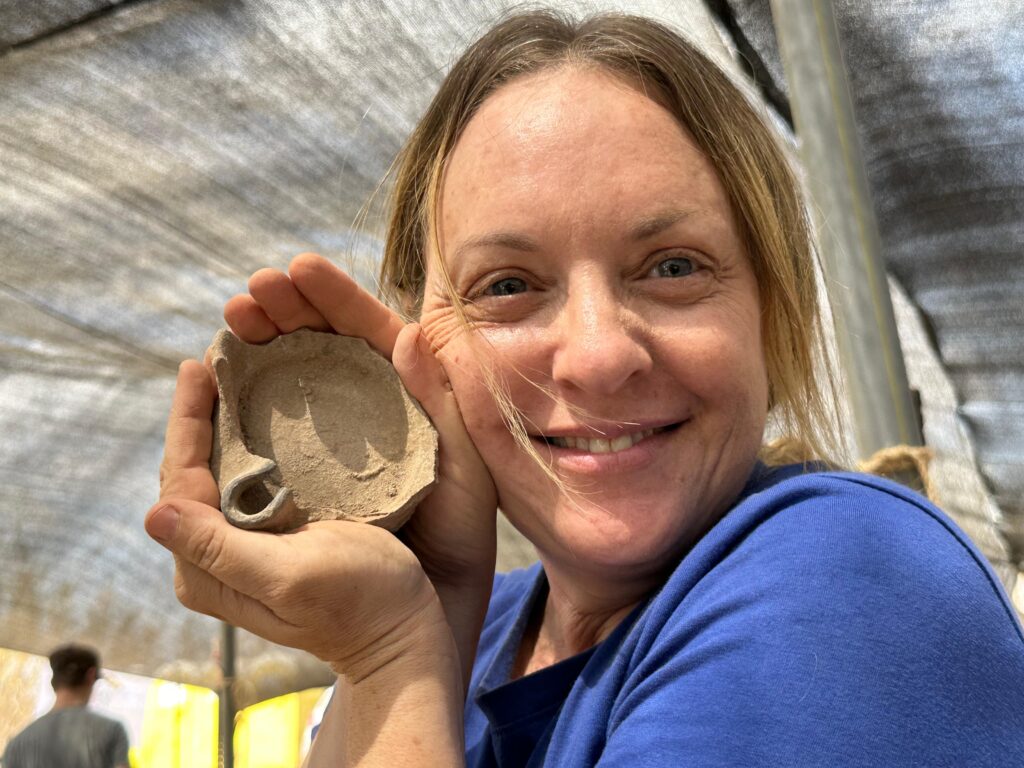
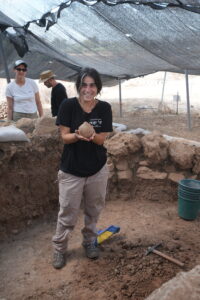
Excavations to date have recovered Late Bronze Age Egyptian scarabs bearing royal cartouches, ceramic figurines, cult objects, and well-preserved architectural remains, attesting to Egyptian imperial presence and Philistine cultural influence in ancient Canaan. The site’s intact stratigraphy makes it an ideal training environment. Further information is available at the project’s official website: tellqana.com
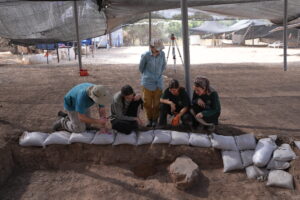
The Tell Qana Archaeological Project offers a hands-on experience that combines excavation, academic learning, and digital archaeology in one integrated program. Participants work alongside professional archaeologists and Bar-Ilan University faculty, taking part in the daily life of an active excavation while gaining practical and scholarly training.
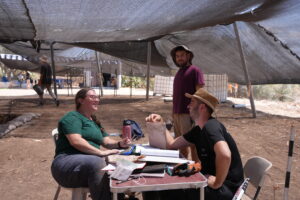
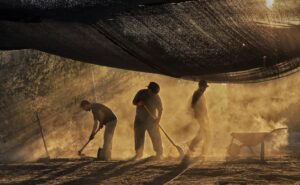
Each day begins in the field, where students learn to excavate, read stratigraphy, identify architectural remains, and document loci and finds in accordance with professional archaeological standards. The work is both physical and analytical, allowing participants to engage directly with the archaeological record as it emerges from the ground.
In the afternoons, the focus shifts to the laboratory. Participants sort and study pottery and other finds recovered during excavation, learning how ceramics and small artifacts are used to date contexts and reconstruct past life at the site. They also take part in artifact registration, processing, and selected forms of digital documentation.
The program is enriched by lectures and seminars delivered by BIU faculty and guest scholars on the archaeology of Tell Qana, the Yarkon Basin, and the Bronze and Iron Age southern Levant. Regional excursions further place the site within its broader historical and cultural landscape.
This is not only a field school, but an opportunity to experience archaeology as a full research process, from excavation and interpretation to analysis and documentation.
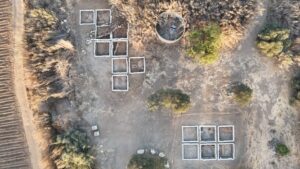
A hallmark of the Tell Qana Archaeological Project is the seamless integration of advanced digital technologies into every stage of the research process. Participants do not simply observe these methods in use. They work directly with the same professional tools that are increasingly central to archaeological fieldwork, analysis, and publication.
Through structured, hands-on training, students gain practical experience in photogrammetry to produce high-resolution 3D models of excavation areas, architectural remains, and individual artifacts. They are introduced to drone-based aerial survey for mapping site topography, generating orthophotos, and documenting the progress of the excavation season from above.
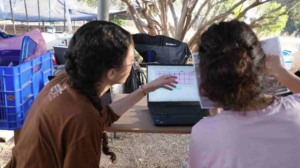
In the field, participants use tablet-based recording systems that connect directly to the project database, enabling archaeological contexts to be documented in real time with speed and precision. They also work with total station and RTK -GPS equipment to establish accurate spatial control for excavation features, sections, and the overall site plan. In addition, the project introduces students to close-range LiDAR and 3D scanners for documenting excavation areas and selected finds.
This digital component gives participants far more than technical exposure. It provides them with practical and academically valuable skills that reflect the direction of contemporary archaeology and prepare them to contribute meaningfully to future research, field projects, and professional work in the discipline.
Excavation is conducted during the cooler morning hours. Afternoon sessions at Bar-Ilan University are dedicated to laboratory work, pottery analysis, and academic instruction.
| Time | Activity | Type |
| 05:30 | Departure from Bar-Ilan University to Tell Qana | Field |
| 06:00 – 08:30 | Excavation | Field |
| 08:30 – 09:00 | Breakfast at the site | Break |
| 09:00 – 11:00 | Excavation | Field |
| 11:00 – 11:15 | Break | Break |
| 11:15 – 13:00 | Excavation and wrap-up; return to Bar-Ilan | Field |
| 13:30 – 14:30 | Lunch at Bar-Ilan University | Break |
| 14:30 – 17:00 | Pottery Analysis: Reading, washing, sorting, and initial classification by period and ware type. | Lab |
| 17:00 – 18:00 | Academic lecture/seminar, or lab session in artifact registration, 3D documentation, or GIS | Lecture |
| 18:00 | End of academic day | — |
| 19:00: 20:00 | Dinner |
Schedule is subject to adjustment on excursion days or in response to site conditions.
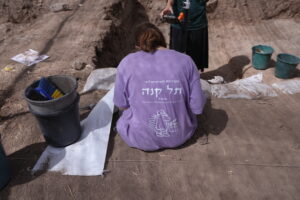
The Tell Qana Field School is formally recognized as an academic course by Bar-Ilan University. Upon successful completion, participants receive a transcript documenting the credit hours earned, which may be transferred to their home institution in accordance with that institution’s credit-transfer policies. Students are encouraged to confirm credit-transfer arrangements with their home institution prior to applying.
Lecturer, Martin (Szusz) Department of Land of Israel Studies & Archaeology, Bar-Ilan University. Research specializations: Bronze and Iron Age material culture of the southern Levant, Egyptian-Canaanite cultural interaction, digital field methods, and GIS-based spatial analysis.
Staff Archaeologist at the Israel Antiquities Authority, she co-directs the excavation and has extensive experience in field archaeology and stratigraphic analysis. Her research specializes in archaeology from the Late Roman to Byzantine periods.
Faculty Member, School of Social Work, Bar-Ilan University. Dr. Oreg co-directs The Lab for Mending Fragments at the Tell Qana Archaeological Project, researching therapeutic interventions through excavation and pottery restoration, as well as integrating special populations into citizen-science fieldwork.
Bar-Ilan University – Martin (Szusz) Department of Land of Israel Studies & Archaeology, Faculty of Jewish Studies.
Israel Antiquities Authority – Official licensing authority for archaeological excavations in Israel. IAA staff participate in field supervision throughout the season.
| Program | Credits | Price |
| 1 Week | 2 | $240 |
| 2 Weeks | 4 | $480 |
| 3 Weeks | 6 | $720 |